I was thinking that I would like to make the felt more robust and to be able to rub the felt both from the inside of the pot and the outside at the same time. I thought that if I made a different kind of mould with friction beads inside, this might work.
So I made a mould using a cut off of a pair of tights filled with aduki beans.
 I then applied the wool wisps in the same way as previously but in more dense layers.
 The pot was then rolled around on the felting mat. This was very much like kneading dough and I found that I could be quite brutal, slamming the mould down and pushing it around.
I also though that it would be a good idea to step up the heat to aid the felting process, so I gave the pot several shots of steam from a steam cleaner.

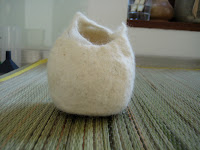 It became clear that this was working very well and that the felt had formed into a tougher shell than in the previous experiments.
So I then put the pot in the tumble dryer, wrapped up in a piece of net curtain, a bit like a steamed pudding.
I gave it 15 mins on a high temperature and then took it out, opened up the tights and removed the beans. The empty tights were then peeled away, the pot rinsed and left to dry.
This has resulted in a much less fragile object. I am going to see what this technique offers in the next few experiments.


 Today's challenge is to add colour and to see whether the tumble dryer part of the process can be used more extensively. Same mould of tights and beans was used as a starting point. So the first pot today uses red as the first layer of colour, then dark chocolate brown to build up the body. I gave this some work by hand to start off the process, then put it in the tumble dryer for about 30 minutes. I ended up with a tight 'egg'. I cut off the top with a scalpel and tipped out the beans.


 I then applied the wool wisps in the same way as previously but in more dense layers.
  The pot was then rolled around on the felting mat. This was very much like kneading dough and I found that I could be quite brutal, slamming the mould down and pushing it around.


 It became clear that this was working very well and that the felt had formed into a tougher shell than in the previous experiments.
 Well, these are the first attempts in a series of felt making
 balloon whilst initially drying out the pot to keep the shape.


